
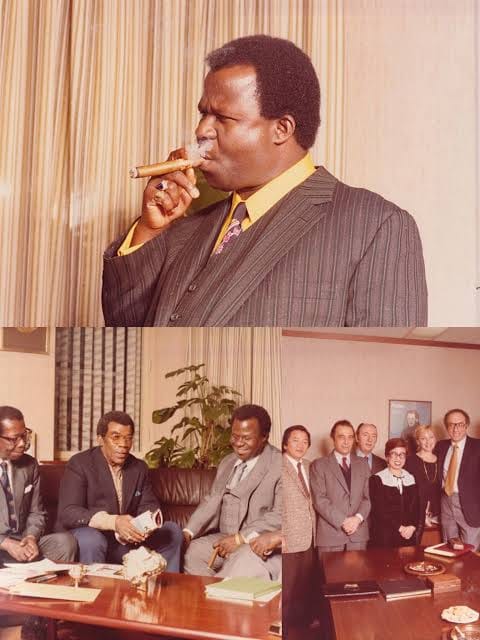

There was no gold mine to show, no mountain of cash to count and no fortune waiting behind a locked vault. Yet, for years, John Ackah Blay-Miezah persuaded people to believe that billions of dollars lay hidden somewhere in the world, waiting for the right man to unlock them.
His weapon was not a gun. It was a story — a story so audacious that businessmen, wealthy investors and influential personalities reportedly bought into it. By the time the truth began to catch up with him, Blay-Miezah had become one of Ghana’s most notorious figures in international financial fraud.
He was not merely selling an investment. He was selling the possibility of becoming rich beyond imagination.
### The man who invented a fortune
Born John Kolorah Blay in 1941, in Ghana, Blay-Miezah reportedly grew up in modest circumstances and sold kerosene to help pay for his education. In 1959, he travelled to the United States, where he claimed connections and academic credentials that later came under scrutiny.
But his most consequential reinvention came when he presented himself as the custodian of an alleged fortune hidden overseas.
He called it the Oman Ghana Trust Fund.
According to his story, Ghana’s first president, Kwame Nkrumah, had arranged for billions of dollars in wealth to be kept abroad. Blay-Miezah claimed he could help release the money, but needed investors to cover the costs of unlocking it.
There was one irresistible promise: those who put money in would receive extraordinary returns.
The problem was that investigators found no evidence that the promised fortune existed.
### How he won the confidence of the powerful
Blay-Miezah understood that people often judge credibility by appearances. He cultivated an image of wealth and sophistication, moved among influential circles and operated from prestigious locations.
His story attracted investors who believed they were participating in an opportunity to access Ghana’s supposed hidden wealth. Some were experienced professionals who might ordinarily have been expected to question such claims.
In April 1986, TIME magazine reported that Philadelphia authorities accused Blay-Miezah and an American associate of swindling at least $18 million from approximately 300 investors in the area. The alleged returns were enormous, but the investors never received the promised payouts.
His operation demonstrated how a convincing narrative, apparent connections and promises of extraordinary profit could overcome even sophisticated investors’ caution.
### The television exposure that changed everything
For years, the scheme survived on the hope that the money would eventually arrive. Each delay could be presented as another obstacle to overcome, requiring more patience and, in some cases, more money.
Then came a major public reckoning.
In 1989, the American television programme 60 Minutes investigated Blay-Miezah and the supposed trust fund. The programme famously described him as “the ultimate con man.” The exposure damaged the credibility of his claims, and he returned to Ghana amid mounting pressure.
Blay-Miezah died in Accra in 1992 while under house arrest. The billions he had promised never materialised, and many investors were left without the fortunes they had expected.
### The man behind a fraud that history remembers
Blay-Miezah is frequently described as a pioneer of advance-fee fraud in Africa, although there is insufficient evidence to establish that he was the continent’s first con artist.
His story has since been examined in Anansi’s Gold, journalist Yepoka Yeebo’s book about his international fraud and the people who believed in his claims.
His lasting notoriety rests on a disturbing paradox: he persuaded people to invest in wealth that could never be found.
The story remains a warning about the power of persuasion, the seduction of easy money and the dangers of confusing confidence with credibility.
In the end, Blay-Miezah’s most valuable asset was not a hidden fortune. It was his ability to make other people believe that one existed.
