
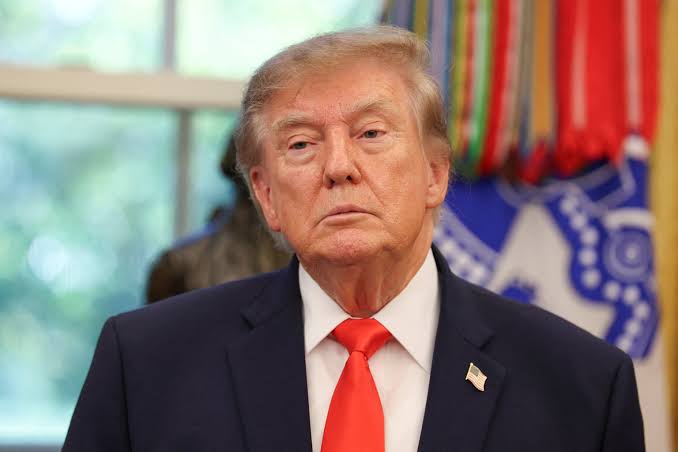

United States President Donald Trump has attributed the Republican Party’s crushing defeat in the midterm elections to the economic consequences of the ongoing war against Iran, particularly the surge in petrol prices.
Despite personally campaigning for Republican candidates and making controversial promises, including financial incentives for voters, the party suffered significant losses as Democrats made historic gains in traditionally Republican strongholds.
Reacting to the outcome, Trump congratulated the Democrats, describing their victory as an achievement they had pursued for 11 years.
“Well, I say this: congratulations to the Democrats. They did a good job. They’ve been looking for this one for 11 years, and they finally got it. But I don’t view it as a hit on me,” he said in a telephone interview with Fox News Democracy 26.
The President also said he was prepared to work with Democrats following their takeover of Congress, insisting that he accepted the election results.
“I can work with them on many things,” he said.
However, Trump acknowledged that the Iran conflict and its impact on fuel prices may have influenced voters, even though many reportedly supported his administration’s position on Tehran.
“I think a part of it was Iran, but at the same time, people agree with what I’m doing on Iran, but they really probably weren’t willing to do the short-term consequence of paying more for gasoline,” he told Fox News.
The war has disrupted global energy supplies, with Iran imposing restrictions on shipping through the strategic Strait of Hormuz, a major route for international crude oil and other essential commodities. The disruption triggered a sharp increase in global oil prices, worsening the economic pressure on consumers.
Following the Democrats’ victories, Trump signalled his intention to resist their legislative agenda, posting a picture of a red baseball cap bearing the inscription “VETO” on social media.
“They can send over, you know, 50 different great bills that they’re all excited about, and I send them back with a nice stamp — ‘veto,’” he declared.
The Democratic gains included major Senate victories in Kansas and Iowa, marking the fifth and sixth Republican-held seats to fall in what has been described as an extraordinary blue wave.
In Kansas, Methodist minister Adam Hamilton defeated Republican incumbent Roger Marshall, becoming the first Democrat elected to the Senate from the traditionally conservative state since 1932.
Iowa also returned a Democrat to the Senate for the first time since 2008, underscoring the scale of the party’s breakthrough.
The victories followed Democratic upsets in Texas, South Carolina, North Carolina and Ohio, where voters rejected Republican candidates despite Trump’s extensive campaign efforts.
In Texas, Democrat James Talarico defeated a Trump-backed Senate candidate, while Gina Hinojosa unseated Republican Governor Greg Abbott, ending decades of Republican control of the state’s top office.
Democrats also retained key Senate seats, including Jon Ossoff’s in Georgia and an open seat in New Hampshire.
The party’s six-seat gain overturned the previous 53-47 Republican Senate majority, giving Democrats control of the chamber.
The Democrats also captured the House of Representatives after flipping Republican-held districts across Pennsylvania, New Jersey, Kentucky, Arizona and North Carolina.
Some of the victories came in areas Trump had comfortably won in the 2024 presidential election, despite Republican efforts to protect vulnerable seats through electoral boundary redrawing.
In Indiana, Democrat J.D. Ford defeated Republican Congresswoman Victoria Spartz in a district Trump had carried by 17 percentage points, a result analysts viewed as an indication of the wider Republican setback.
At the state level, former Atlanta Mayor Keisha Lance Bottoms made history by becoming the first Black woman elected governor in the United States.
Republicans, however, recorded some victories in Florida, where Trump-backed Byron Donalds won the governorship, becoming the state’s first Black governor, while Ashley Moody retained a Senate seat.
Reacting to the scale of the Democratic gains, George Washington University professor Todd Belt described the outcome as “a big wipeout and a strong repudiation of Donald Trump and his policies.”
He identified economic concerns, corruption allegations and public dissatisfaction with the Iran conflict as major factors behind the Republican Party’s poor performance.
